Showing posts with label Alaska. Show all posts

Sunday, October 25, 2020

Celia's Scrapbook and Rabbit Holes

This week I've spent many hours with Celia Sconce Cathcart Holton and her scrapbook from about 1913-1917. She captioned many of the pictures and included names of some of the people. Her writing is difficult to read and the ink has faded over 100+ years. Our digitizer/archiver advised me to write the captions in darker ink so they can be read when the pages are digitized. 

I'm trying to identify as many of the people and places as I can. Rabbit holes are around every corner. I go down some of them deliberately. Others I fall into accidentally. I don't always find what I was looking for, but I always find something that's interesting and somewhat related. I'm spending a lot of time in newspaper archives - publications from Illinois Woman's College in Jacksonville, Illinois where Celia was a freshman and sophomore, 1911-1913 and  Northwestern University, Evanston, Illinois where she was a junior and senior. 

Questions and answers from this week-

A number of Celia's classmates from Illinois Woman's College also transferred to Northwestern. Many of them joined the Alpha Phi and were active in YWCA, Young Women's Christian Association, as was Celia.

Grandma, Florence Fisher Clark Holton (Toots) was also an Alpha Phi, in YWCA, and graduated the same year Celia did, 1915. 

There are many sorority pictures, such as the one above. I don't recognize Grandma in any of them. Did she not take part in the picnics, slumber parties, and so forth? She, her parents, and brother lived in Evanston, not far from the university where her father was a beloved professor. He died from appendicitis in 1911. 

In one of the publications I found an article about Celia's grandmother, Emma Sandusky Sconce, donating $5,000 towards a new music and arts building for Illinois Woman's College. That was a lot of money in 1907. 

In another search on Celia's name, I noticed an article from a Skagway, Alaska newspaper in 1909. I checked it out and found out Emma Sconce was the "Grandma" that accompanied Celia and her parents on a trip to Alaska in 1909. See blog posts about part of that trip back here (check out multiple posts in August and September 2015). 

I enjoy Celia's comments and pictures that reveal what college and small town life were like in the early 1900s. 


Thursday, September 10, 2015

1909 Cathcart Trip - Skagway, Alaska

Anna, Celia & William Cathcart
 ca 1910
16 year old Celia Cathcart is traveling with her parents, Anna and William Cathcart, and "grandmother." We're assuming this was Emma Sconce. Friday, July 9, 1909 the party boarded a ship in Seattle, Washington and headed north to Canada and then Alaska. Celia is my father's mother.
*****************
Thursday July 15
Thursday morning we reached Skagway after 4 day voyage. This is a town of considerable size, but evidently not prosperous, as there are a great number of empty houses and store rooms. Several glaciers are to be seen from the town, likewise a little falls high up on the mountainside. The names are up-to-date and a little high-sounding, no matter if they are a little deceiving. Such appellations as Fifth Avenue, Broadway, and Delmonico are a trifle misleading. At 9:30 we took the White Pass and Yukon Railroad for White Pass. This route proved a very scenic one. The road is winding and very mountainous. Three engines were used the greater part of the time. The air was very fresh and pure but quite cold, being right off the snow-covered mountains. Numerous waterfalls of great height added much to the beauty of the route. The cantilever bridge, a great architectural masterpiece, spans the turbulent mountain stream at one place. A little brown animal was seen scuddling up the mountainside, which was called by some a raccoon. A gopher was also noted. At the summit [sic] of White Pass, the boundary between the U.S. and Canada, an altitude of 3000 ft was attained. At Lake Bennett, we stopped 20 minutes for lunch. The road from there on was less interesting, being nothing but lakes and mountains. The mountains were beautifully colored, however, in delicate reds and yellows, with patches of green vegetation here and there. In the middle of the afternoon, we noticed a great light across a valley, the light much resembling a rainbow.

Later on, Miles Canon [Canyon] was entered, at the foot of which lay the flourishing village of White Horse. We had but little time here, as our ship “The White Horse", the best of the river boats, left at 7:30, carrying before it a scow loaded with cattle, sheep, pigs, and chickens being shipped to Dawson. The cattle had come from Calgary. For some time we sailed on the crooked 30-mile river, then entered the Lewis (?) river, the Yukon not being reached until Ft. Selkirk. The waterway was winding and tortuous, and required a good pilot. The current being very swift, we made rapid progress down the river. Numerous Indian graves were passed, and quite a lengthy stop was made at Hootalinqua, a little town of log cabins, where many Indians resided. Back of the town were said to be gold mines of great extent. In the afternoon, the weather grew very hot, 108° in the shade being recorded. The journey continued until Saturday night with nothing exceptional occurring except for the boat's passage through the Five Finger Rapids. This swift part of the river is so-called because the rocks on one side of the bank extend across to the opposite side in such a manner as to resemble a hand. The passage is so narrow that when our boat went through, the rear side of it knocked against the rock, damaging it somewhat severely. 
*****************

ADDITIONAL INFORMATION

Skagway, Alaska - image ca 1909

image shows steamship in lower middle & long wharf leading to the town


"Once news of the great gold strike in the Yukon spread throughout the country in the summer of 1887, a stampede to the far north began. The shipping companies, glossing over the perils that awaited travelers, settled on a route that took ships along the southeastern Alaskan coast and through the long Lynn Canal directly to a hectic new tent town—Skagway, Alaska. Skagway was the entry point to the White Pass, a gap over the mountains that led to the Yukon River and into the Klondike gold fields. And while the Pass was a daunting journey, an obstacle course with narrow, twisting trails leading to a sky-high summit, all through that first year people flocked to the settlement whose name was inspired by the Indian word Skagus—the home of the North Wind." source   By 1909 when the Cathcart family visited, Skagway was no longer a gold rush boomtown. Prospectors had moved on to west Alaska where gold had been found in Nome. 

******
White Pass and Yukon Railroad - Celia mentions the air was "fresh and pure." Click here to read what an author had to say about "tasting" Alaska's climate back in 1909. 
"You can just taste the Alaska climate," said an old Klondiker, on a White Pass and Yukon train. We were standing between cars, clinging to the brakes—sooty-eyed, worn-out with joy as we neared White Horse, but standing and looking still, unwilling to lose one moment of that beautiful trip.
"It tastes different every hundred miles," he went on, with that beam in his eye which means love of Alaska in the heart. "You begun to taste it in Grenville Channel. It tasted different in Skagway, and there's a big change when you get to White Horse. I golly! at White Horse, you'll think you never tasted anything like it; but it don't hold a candle there to the way it tastes going down the Yukon. If you happen to get into the Ar'tic Circle, say, about two in the morning, you dress yourself and hike out on deck, an' I darn! you can taste more'n climate. You can taste the Ar'tic Circle itself! Say, can you guess what it tastes like?" (Alaska - The Great Country by Ella Higginson, 1908, p 262)

White Pass and Yukon Route was built in 1898 during the Klondike gold rush. It links Skagway, Alaska with Whitehorse, Yukon, Canada. "According to the WP & YR website, in 1898, this narrow gauge railroad was built in only 26 months at a cost of 10 million dollars. It is an International Historic Civil Engineering Landmark, a designation that the Panama Canal, the Eiffel Tower and the Statue of Liberty also hold. The WP&YR railroad climbs almost 3000 feet in just 20 miles and included a steel cantilever bridge, which was the tallest of its kind in the world when it was constructed in 1901." source Click here for photos of the bridge. You can take the same ride today. Click here

*******
White Pass White Pass International Border - "2,865 feet above sea level, finds you at the White Pass Summit, the official border between the United States and Canada.  During the Klondike Gold Rush, there was a contingent of Royal Canadian Mounted Police stationed here to ensure every man, woman and child had a year’s worth of supplies before they continued on their arduous journeys." source

*******
Lake Bennett - Bennett, British Columbia

"Lake Bennett, darkened once by the rafts of gold-seekers, but disturbed now by no more than a ruffling wind or the spatter of water-drops behind a string of ducks rising to fly. Bennett, British Columbia, Canada is an abandoned historical town next to Lake Bennett. It was built during the Klondike Gold Rush of 1897–99 at the end of the White Pass and Chilkoot Trails from nearby ports of Skagway and Dyea in Alaska. Gold prospectors would pack their supplies over the Coast Mountains from the ports and then build or purchase rafts to take them down the Yukon River to the gold fields around Dawson City, Yukon." source 

*******
town - White Horse  - "1901     Whitehorse developed quickly from a jumble of tents to a sizeable town. The settlement was originally located on the east bank of the river, at the terminus of Norman Macauley's tramway, but moved to the west bank with the completion of the railway. The first survey of the settlement, in 1899, shows what the Yukon Sun newspaper referred to as "a very cleverly laid out town."

      At the turn of the century, "white horse" was a common term for a standing wave or whitecap. The rapids just upstream from the town got their name this way. Although the community had commonly been known as Whitehorse - often spelled as two words - by prospectors and traders, the White Pass & Yukon Route wanted to change the name to Closeleigh, after the company's British backers, the Close Brothers. The Territory's Commissioner, William Ogilvie, ruled that the town's original name should be kept, since it was so well established.
      By the spring of 1900 there were wholesale houses and retail mercantile esatblishments, a hardware store, six large hotels, two drug stores, a brick yard, 2000 feet of warehouses on the waterfront, three churches, an athletic club and an electric light plant. Tents, log houses or clapboard buildings were found on practically every lot." source 

*******
White Horse in Five Finger Rapids 1920
source
ship "The White Horse" - Here's some fascinating information on the ship Celia and her family took up the river to Dawson. "The Whitehorse (originally the White Horse) had a much longer and more colourful history on the river, being built in 1901. She was described as a wooden sternwheeler, 167 feet long, with a 34.5-foot beam and 4.5-foot hold. Her gross tonnage 986.65 tons, registered as 630.69 tons. She had two decks, was of carvel build, and had a straight head and square stern, with two bulkheads. She had accommodation for 64 people.

    The engine room was 34.5 feet long, housing 2 horizontal engines made in 1898 by B.C. Iron Works, and originally installed in the Stikine River steamer McConell. The engines had two cylinders with a 16-inch diameter and 72-inch stroke, producing 17 NHP.
    In 1901 the British Yukon Navigation Company was in its heyday, and the White Horse was one of three large sternwheelers built that year (the others being the Dawson and Selkirk). The crew took only 43 days to build her, and after being christened with champagne by Miss Tache, daughter of the Public Works Superintendent, she was launched on May 29 1901.
    During her 54 years on the river, there were many adventures. In June 1902, she was declared a "plague ship" and quarantined in the river downstream from Dawson for 16 days. Arriving at Dawson June 2 with a crew of 34 and 125 passengers, a 2nd class passenger was diagnosed as a suspected case of smallpox. The disease never appeared, however, and the White Horse was allowed to go back into service.
    Navigation on several parts of the river were tricky, and in both 1909 and 1914, she hit the wall while descending through Five Finger Rapids, doing fairly extensive damage to the railings. In 1935, she was sent out to rescue the Yukon, which had been damaged by ice on Lake Lebarge and beached. The Whitehorse was guided through the ice during that mission by the company's airplane.
    As gold mining slowed down, more and more effort was put into promotion of the tourist trade, and the White Horse was modified many times to increase passenger comfort. On June 19 1916, with the Casca, she took the first of BYN's successful Midnight Sun excursions to Fort Yukon." source

jht - Celia mentions the ship hitting the rock - "The passage is so narrow that when our boat went through, the rear side of it knocked against the rock, damaging it somewhat severely." 

*******
Fort Selkirk - established as a trading post in 1852. Photos here

*******
Click here for a description of the same route the Cathcart family took. 

****************
See July & August for more posts about this trip. Or click on label Alaska.


Thursday, August 27, 2015

1909 Cathcart Trip - Port Simpson, Kitchikan, Wrangell, Juneau

Anna, Celia & William Cathcart
 ca 1910
16 year old Celia Cathcart is traveling with her parents, Anna and William Cathcart, and "grandmother." We're assuming this was Emma Sconce. Friday, July 9, 1909 the party boarded a ship in Seattle, Washington and headed north to Canada and then Alaska. Celia is my father's mother. 
*****************

Tuesday July 13
Tuesday the weather was as good as usual. The cloud effects we saw on this day were particularly fine. In places, the low dark stratus clouds would envelop the mountain in a maze of darkness, while above them the cirrus clouds would break away to disclose the last rays of the sinking sun. The sun never sets in this country until 9:30 or 10:00. Its reflections on the water are superb in their coloring. We also saw quite a number of porpoises. A porpoise is a large fish, from 3 to 5 ft in length, with a reddish colored body and light green fins and tail. It spouts water like a whale does. They are fond of racing along with a steamer, being sometimes known to swim a mile by the side of the vessel. Port Simpson was the next stop after Prince Rupert. The Alaskan towns are all very similar. They are built up on piles high above the water. The streets and sidewalks are all of boards which on account of the climate are nearly always damp and slippery. The houses are built on either side of the street, and are merely shelters, beauty not being considered. The walls seemed to be patched up with all sorts of boards, sticks, or mud. In front of most of the houses were totem poles. Kitchikan was reached about 3:00 Tuesday afternoon. It is also built on piles, at the side of a mountain. In the town is a little falls, which in the right season is crowded with salmon. About 3 miles from the town is another falls, greater than the first. This we saw from the boat. Large lumber mills and a shingle mill are located here. ; [sic] About 11:00 the boat stopped at Wrangell, remaining there until 7:30 Wednesday morning. Some very hideous totems were seen here. Small pieces of ice were now frequently seen in the water, having broken off from a nearby glacier of great extent. About 8:00 we landed at Juneau, the capital of Alaska. It is very pretty as a town, nestled in at the foot of two lofty snowcapped mountains. Clean-looking restaurants, fashionable jewelry stores and up-to-date vegetable markets characterized the place. The public building is located on a hill overlooking the city. Just across from Juneau, on Douglas Island, are the famous Treadwell mines and stamp mills. The Glory Hole, a great cave in the rocks where an entrance to the mines is effected, is plainly seen from the boat. I neglected to state that about 4:00 on Wednesday afternoon before reaching Juneau, we passed a great glacier known as Sumturn glacier. It is said that only 1/8 of the total glacier is in evidence, the remainder being submerged in the water. A little farther down our course stood a great iceberg which had probably broken off from the glacier as had other smaller pieces of ice. The coloring of the iceberg was gorgeous, it being a greenish blue in places and a whitish yellow other. It was a very irregular mass, much resembling a cave in the side of a detached hill.
*****************

map from Alaska by Ella Higginson, published 1909

Port Simpson, British Columbia, Canada - The Tsimshian people spent winters in this area. Then Fort Simpson was built and changed the lives of the native people. "In the village surrounding the fort there gathered more than 2,000 Tsimshian ..." source more information here

Kitchikan/Ketchikan, Alaska - more information here. Image - Ketchikan in 1908; source 
"Ketchikan's History dates back to 1883, when a man named Snow built a salmon saltery. Two years later, businessmen from Portland, Oregon, hired Mike Martin to investigate possibilities for building a salmon cannery on the banks of Ketchikan Creek. By the early 1900's, Martin and the cannery's manager, George Clark, had set up a partnership and had opened a saltery and a general store. Two years later, with the fishing trade flourishing, Ketchikan was definitely in business. And by 1900, with a population of 800, the town was officially incorporated." source

Wrangell - "Wrangell is the third oldest community in Alaska, and the second oldest community in Southeast, and the ONLY city in Alaska to be ruled by four nations and under three flags... Tlingit, Russia, England, and the United States." source Click here to see totem poles from around 1909. More about Wrangell here and here


Juneau - ca 1909; source  The area that became Juneau was a long time fishing ground for the Tlingit Indians. In the late 1800s gold was found and that started a stampede. The town of Juneau was laid out. The boomtown became a mining center. In 1906, just three years before the Cathcarts' visit, Juneau became the state capital. Juneau was named after Joseph Juneau, a Canadian prospector. Read more here. 

Douglas Island - Treadwell Mines & Steam Mills - "The Treadwell gold mine ... was in its time the largest hard rock gold mine in the world, employing over 2,000 people. ... Although John Treadwell had twelve years of experience in both placer and lode mines, he was a carpenter and builder by trade who had come to Alaska prior to the Klondike Gold Rush." Wikipedia   Read more here

Glory Hole - massive pit that resulted from gold mining

Sumturn Glacier - unable to locate information on this

Color of glacier ice - "Majestic glaciers and thick snow banks act like filters that absorb red light, making a crevasse or deep hole appear blue." Read more about light, color, and glaciers here. 

Check the list of August posts on the right for more posts from Celia's diary.


Monday, August 17, 2015

1909 Cathcart Trip - Canada - Vancouver To Prince Rupert

Anna, Celia & William Cathcart
 ca 1910
16 year old Celia Cathcart is traveling with her parents, Anna and William Cathcart, and "grandmother." We're assuming this was Emma Sconce. Friday, July 9, 1909 the party boarded a ship in Seattle, Washington and headed north to Canada and then Alaska. Celia is my father's mother. 
*****************

Friday July 9 .
[in Seattle] Friday we spent in shopping and in resting. We left the hotel about 9:30 and got aboard the Princess Charlotte where we spent the night, arriving at Vancouver about 8:30. The Sound was very smooth and the stateroom a model of comfortable luxury, so my first night on the water was a most pleasant one. We spent the day at the Vancouver Hotel which is under the management of the C.P.R.R. We didn't venture out all day, as it rained, except to go across the street to an Indian curio shop. One peculiar thing about the street car system of Vancouver is that the conductors pass around a little mug into which each passenger drops his fare so that the conductor is not tempted to be dishonest.

Friday night we left Vancouver on the Princess Royal for Skagway. The boat was billed to leave at 11:00, but there was so much loading to be done that it was between 3 and 4 before we left. The ship was one owned by the C.P.R. It was a three-decker, and a very big affair. It was crowded to its utmost, as there had to be two sittings at the dining room which accommodated about 100, The channel was very narrow the first day, as we passed through the Seymour Narrow, the water was very calm and of a dark green in color. About 4:30 Sunday evening the ship made its first stop at Alert Bay. This is an Indian village. The houses in which the natives lived were all alike except for a difference in the color of paint used. They all had three windows in the front, one high one and one on each side of that but lower down. These, of course, were in the fronts of the houses, which were perfectly plain except for a set-in doorway. The roofs were all V-shaped. To one side of each doorway stood a totem pole. These are great wooden monuments, carved and painted to represent all sorts of hideous figures such as persons, fish, and birds. These poles are the record of the family history of each household, and are very dear to the Indians. Sunday night, whales were seen at quite a distance from the boat. Later, it became very rough, and many persons got desperately seasick.

Monday July 12
Monday morning it was calm again. The first stop was made about 8:30 at Swanson's Bay, where a big pulp factory is located. The day was foggy as its predecessor had been, and the clouds hung very low over the heavily wooded mountain. Snowcapped peaks were to be seen, and at their base, pretty waterfalls. No stops were made during the day, but one Indian village was passed. Near this were numerous fishing boats in which men were manipulating their large nets. Snow-capped mountains were still plainly to be seen. Late in the evening, Prince Rupert was reached. On account of the large amount of freight to be unloaded, the ship remained here quite long, Prince Rupert is the terminus of the Grand Trunk Pacific Railroad, and a great deal is expected of it. It is expected to become the city of southeast Alaska.

*************

According to this site, the Princess Charlotte was a new ship in January 1909. In 1949 after 40 years of service in the Pacific Northwest waters, Princess Charlotte was sold to a Greek shipping line and was in service another 15 years. 


The “Princess” title came to be used for CPR [Canadian Pacific Railway] ships because of the aging CPNC [company bought by CPR] vessel Princess Louise. The popular “Empress” ships were already established in the Pacific, so the decision was made to carry out a royal theme, with smaller coastal ships bearing the prefix “Princess”. In the 1960s Stan McDonald chartered one of the Princess ships and became excited about cruising. His company, Princess Cruises, was named after the Princess Patricia, the ship he chartered a number of times.  source 

Vancouver Hotel, Vancouver, British Columbia, Canada - 1909 postcard

CPRR & CPR - Canadian Pacific Railroad

Princess Royal - ship to Skagway; image ca 1910


 "Princess Royal, a larger wooden ship of 227 feet having 72 staterooms with 144 berths also from BC Marine Railways was fitted with large triple expansion engines designed for 15 knots. She made her maiden voyage on July 18, 1907 sailing to Alaska." source 

Seymour Narrows - a treacherous part of the journey

Alert Bay, British Columbia, Canada - Indian Village, totem poles. Celia's descriptions of the houses were very accurate based on the pictures at the link below. Click here for images of people & buildings at Alert Bay in 1909. You can see some of the totem poles that Celia didn't care for. History of totem poles here


Swanson Bay, pulp factory - Click here for a history of the town

History of Prince Rupert & Terminus of Grand Trunk Pacific Railroad - Click here


It's fascinating to follow the ship's route through narrow waterways of the Inside Passage

*********
Congratulations for making it to the end of the post. I hope you explored the links. I was surprised at the number of photos I could find from the time the Cathcart family was cruising these waters. I keep thinking about 16 year old Celia from very small town Illinois and all that she's experiencing on this trip. 

annotations added to this map


Tuesday, August 11, 2015

1909 Cathcart Trip - Seattle

Anna, Celia, William
ca 1910
16 year old Celia Cathcart is traveling with her parents, Anna and William Cathcart, and "grandmother." We're assuming this was Emma Sconce. Monday, July 5, 1909 the party arrived in Seattle, Washington after a cross country train trip from Sidell, Illinois. Read about that here. Celia is my father's mother.

Seattle was hosting the Alaska-Yukon-Pacific Exposition June - October 1909.
**************************
Tuesday July 6
The next morning (Tuesday) we went out to the Exposition grounds. The buildings were all of a cream colored plaster-like substance. The main ones were arranged so as to face a rectangular park which consisted of sunken gardens. Beautiful flowers such as pansies, poppies, carnations, geraniums, foxgloves, Canterbury bells, etc. covered the terraces which rose from the walk to the buildings. We visited the Alaska, Hawaii, and Government Buildings, then went to the Eskimo Village on the Pay Streak. There we found Mr. Baber, who conducted us through the main amusements, such as Igerrote [Igorrotes] Village, Trip along the Yukon, Human Laundry, Scenic Railroad, etc. In the evening saw Ethel Barrymore in "Lady Frederick" at the Moore Theatre. In the boudoir scene she says to the desperately desperate Charley: "You have noticed that dark streak under my eye which gives so much feeling, so much pathos and sentiment to my expression?" "Yes", whispers Charley. "Well, here it is", as she picks up the pencil.

Wednesday July 7
Wednesday we again visited the fair, taking in the European, Oriental, Agriculture, Manufacturers, Forestry, and Music Pavillions [sic]. In the forestry building were two "big sticks", one 74 ft long by 4 ½ ft square, the other 156 ½ ft long by 17 in. square. The Washington game exhibit was especially fine; it represented a woodsy scene showing the cataract, hills, boy fishing, and wild animals. At the Music Pavillion [sic] we heard the Innes Band and also enjoyed two solos from a harpist. At night we admired the illuminations, and then went to the Natural Ampitheatre and saw the Iola Company, a squad of 48 K's of P, give their drill. 

Thursday morning was spent in taking an auto ride through the city. We went up on First & Last Hills, Capitol Hill, and Beacon Hill. Went through Volunteer Park and saw Washington Lake. Saw the men in their work on the streets, making them wider and removing the hills. At the Exposition we visited the Fine Arts Gallery, in which we saw nothing exceptionally appealing but a picture of Samson slaying a lion. The gladiator stood astride the monster, forcing its jaws open with his own powerful hands. The scene was in the mountains. We also went to the Canada building and to the Canadian Klondike where we heard a picture-talk.

**************************

Exposition - The Alaska-Yukon-Pacific Exposition 
From article about the Exposition:
“The Alaska-Yukon-Pacific Exposition opened in Seattle on June 1, 1909 with nearly 80,000 visitors. Originally planned for 1907 to mark the 10th anniversary of the Klondike Gold Rush, the Exposition was postponed two years to avoid a conflict with another summer long exhibition in Jamestown, Virginia, marking that town’s tercentenary. In addition to providing time in which to raise additional funds, the delay gave the planners the opportunity to expand the original concept from that of a commemorative Alaska exhibit to a fair encompassing all the Pacific Rim countries and territories. The new scope of the AYPE would not simply commemorate the past, but display the value of commercial trade with the Pacific Rim, celebrate a new era of commercial and industrial expansion and promote Seattle as its center. Nationally known landscape architects from Boston, brothers John and Frederick Olmstead, designed the fairgrounds. The central portion of the grounds was oriented along axes that exploited the natural beauty of the setting, with views of Mount Rainer, Lake Union and Lake Washington. Built on 250 acres of the largely undeveloped campus of the University of Washington (and partially funded by the state legislature for later use by the University), the AYPE grounds were close to downtown and convenient transportation. Though most of the buildings, designed by John Galen Howard, were too poorly built to survive, the landscaping of the grounds added value to the university by removing wilderness and opening new possibilities for future university installations.” source     jht - We saw remnants of this layout when we toured the University of Washington campus with our grandson years ago.

Click for images of Government Building and Alaska Building

Check out the Hawaii Building - Our relatives were likely dressed like the men and women in this postcard. Think how much space those dresses would take up in a suitcase! I wonder if they traveled with trunks such as pictured here.


Eskimo Building - It was supposed to look like a glacier.  source


Pay Streak - midway at the Exposition. Click here for an explanation and great pictures. One of the pictures shows a woman with the "native" children. I wonder if this is how Anna Cathcart and Emma Sconce dressed for the fair? 

Mr. Baber - mentioned earlier in the diary. On the train from Chicago to St. Paul, Minneapolis they met Helen Baber, "whose father my father had known a long time ago." 

Igorrotes – Filipino group that appeared in an anthropological exhibit at the Exposition. Slides #38-40, 42, 43 here 

Human Laundry – part of the Midway at the Exposition; I couldn't find an explanation of what this was

Ethel Barrymore in Lady Frederick at the Moore Theatre, images here and here. The theatre is still in use in Seattle. 

From Bill Holton's Recollections - "Mother took me to the Hartman Theater in Columbus to see Ethel Barrymore in "The Corn Is Green". I must have been in high school. That was my first real stage show, and it was wonderful to see an actress of the calibre [sic] of Ethel Barrymore." jht - Do you think Celia remembered her experience in Seattle and shared that with her son Bill as they watched Ethel Barrymore in person at the Hartman Theatre? I like to think that she did. *I found a program for a performance of this play at the Hartman on October 1943. Celia died December 1942. Barrymore performed "Whiteoaks" at the Hartman Theatre in January 1939. Perhaps that's the play that Bill and Celia saw. 

European, Oriental, Agriculture, Manufacturers, Forestry, Music Pavilions - click here for photos. Click here to see photos of the Forestry Building, including the big stick

Innes Band - from New York City; more here

Iola Company, K's of P - This must be Knights of Pythias. Click here for a newspaper article about a jubilee that was held the same time as the Exposition. It mentions a parade but doesn't say it was part of the Exposition. 

Auto ride through Seattle - removing hills - This is an interesting article on how Seattle's terrain has been shaped and reshaped over the years - with some pictures of what Celia and her family might have seen on their drive. More here

"heard a picture-talk" - from Wikipedia - "The first known public exhibition of projected sound films took place in Paris in 1900, but decades passed before sound motion pictures were made commercially practical. Reliable synchronization was difficult to achieve with the early sound-on-disc systems, and amplification and recording quality were also inadequate. Innovations in sound-on-film led to the first commercial screening of short motion pictures using the technology, which took place in 1923." more here

Click here to read an account written by Mateel Howe when Mateel visited the Exposition in June 1909. 

Whew! That's it for Seattle! I keep wondering how this group from tiny Sidell, Illinois felt about aIl they were seeing and experiencing. Sidell is only a few blocks wide and not many blocks long with about 1,800 people in the township in the 1910 census.  I enjoyed looking up links for this post.  I hope you enjoy Celia's account as well as the background information I found. 

*September 21, 2015 - information about Barrymore performance in Columbus, Ohio updated and corrected

Saturday, August 1, 2015

1909 Cathcart Trip - Sidell to Alaska - Part 1 - Sidell to Seattle

A few weeks before our Alaska cruise I was going through some of the family archives and came across this.
FROM ILLINOIS TO ALASKA, 1909
Celia Cathcart

Celia Sconce Cathcart turned 16 on May 9, 1909. In July she traveled to Alaska with her parents William Gabriel and Anna Sconce Cathcart as well as “Grandmother,” probably Emma Sandusky Sconce. Celia is my father's mother.

My father typed this manuscript March 10, 1965, probably from a handwritten diary. The original no longer exists. He wrote at the top of the first page “(with her father, mother, and grandmother (?Sconce)”

We had approximately the same itinerary as Celia and her parents, over 100 years later! However, they had a long train ride from Sidell, Illinois to Seattle before starting to Alaska. 

See what you think as you read her account. My guess is that she was writing this for school or perhaps for the local newspaper. I think if this was just for her personal diary there would be much more about her family and her own feelings. The account reminds me of the letters I wrote for the Madison Press when I lived in Germany and later when a friend and I traveled around Europe for a month and sent letters to the newspaper editor. 
Anna, Celia & William Cathcart
ca 1908

Here's the first installment

***************************

FROM ILLINOIS TO ALASKA, 1909

A diary of Celia S. Cathcart

Friday, July 2, 1909
     Left home at 9:36, and went from Danville at 2:05. On the sleeper I sat across from an old duffer from Texas who called me "The Little Alaskan Traveller from Sidell". He was a terrible windjammer, but between his outbursts of conversation I managed to complete "The Call of the Wild" by London. Arrived at Chicago at 5:25 and went to the Grand Pacific where we engaged a room, as our train didn't leave until 10:00 that night. There was a college meeting of some sort representing Cornell, and they managed to keep something going all the time. While we were at dinner being entertained by Mr. Weig, a fearful storm came up. It was of short duration, however, as when we went to the depot the weather was delightful. The route upon which we travelled was the C. B. & Q. We slept real well on the train, as it was nice and cool even on the sleeper. The next morning we became acquainted with a Helen Baber, whose father my father had known a long time ago. At St. Paul we took the Great Northern Route, having travelled all morning on the C. B. & Q. which follows the Mississippi in its meanderings. The crops of oats, wheat, corn, and barley looked very well, though they were not so far advanced as in Illinois. We passed by a great number of very pretty little lakes, along which were situated cottages and a few summer hotels. Saturday evening the sun set about 8:30.

Sunday, July 4
The next morning we entered Montana. The scenery was very monotonous; nothing but hills, sagebrush, and black-eyed Susans, with now and then an adobe cabin. Late in the afternoon we passed by an Indian reservation known as the Flathead reservation. The Indians had been having a big powwow and all came down to the train decked in gala attire. Still later, about 8:00, we entered the Rocky Mountain District. By morning we were again out on the plains, our highest elevation during the night having been 5200 ft. In the afternoon we travelled across the Cascades. The road was very winding and in places the grade seemed quite steep, although the civil engineer who was on the train said that it was only 100 ft. per mile. We went through a tunnel 3 miles long, but instead of the regular train engine (steam), an electric one was used so that the smoke was done away with. The road was so winding that at times three tracks could be seen, one above the other as in tiers, At Everett we obtained our first glimpse of Puget Sound. Got into Seattle about 9:00 at night.

Went to the Hotel Perry, a large handsomely furnished building  recently erected.
**********************
Comments from JHT

"Home" was Sidell, Illinois. 

They took the train from Danville, about 22 miles from Sidell. 

Something tells me that Celia, at age 16, would not have appreciated being called "The Little Alaskan Traveller from Sidell."

I smile when I sense her desire to finish her book rather than talk with or listen to the "windjammer" sitting across from her. Many of us can feel a kinship here - traveling with a book and becoming absorbed in the story. 

Click The Grand Pacific Hotel in Chicago 1912 for an image

C B & Q Railroad – Chicago, Burlington, and Quincy Railroad, named for the original route between Chicago, Illinois; Burlington, Iowa; and Quincy, Illinois. As Celia states, it followed the course of the Mississippi River. 

At St. Paul, Minnesota, the group took the Great Northern Railway across the country. (Click to see map of the route)

Celia mentions the Flathead Reservation in Montana. Click here to see pictures of the reservation in 1909 - including Indians "decked in gala attire." 

Celia says the steam locomotive was changed for an electric one to go through a tunnel. The Cascade Tunnel was 2.6 miles long through Stevens Pass. Use of the electric locomotive was new in 1909. Later a second tunnel was constructed. Read more here and here. 


In Seattle they stayed at the Hotel Perry. It opened just two years prior to their arrival. The hotel no longer stands (demolished in 1996). This 1909 ad touts the features of the hotel


Check back for adventures in Seattle and then Alaska!


Friday, July 31, 2015

Cruise - Home - Going & Coming

Leaving home
We had been in the space on the left
Goodbye Seattle

***********

In Victoria the last night
Our ship in Victoria

A week later - we left Victoria, British Columbia about 11:30 at night. 
I sat on the balcony and watched the lights of the city fade into the night. 


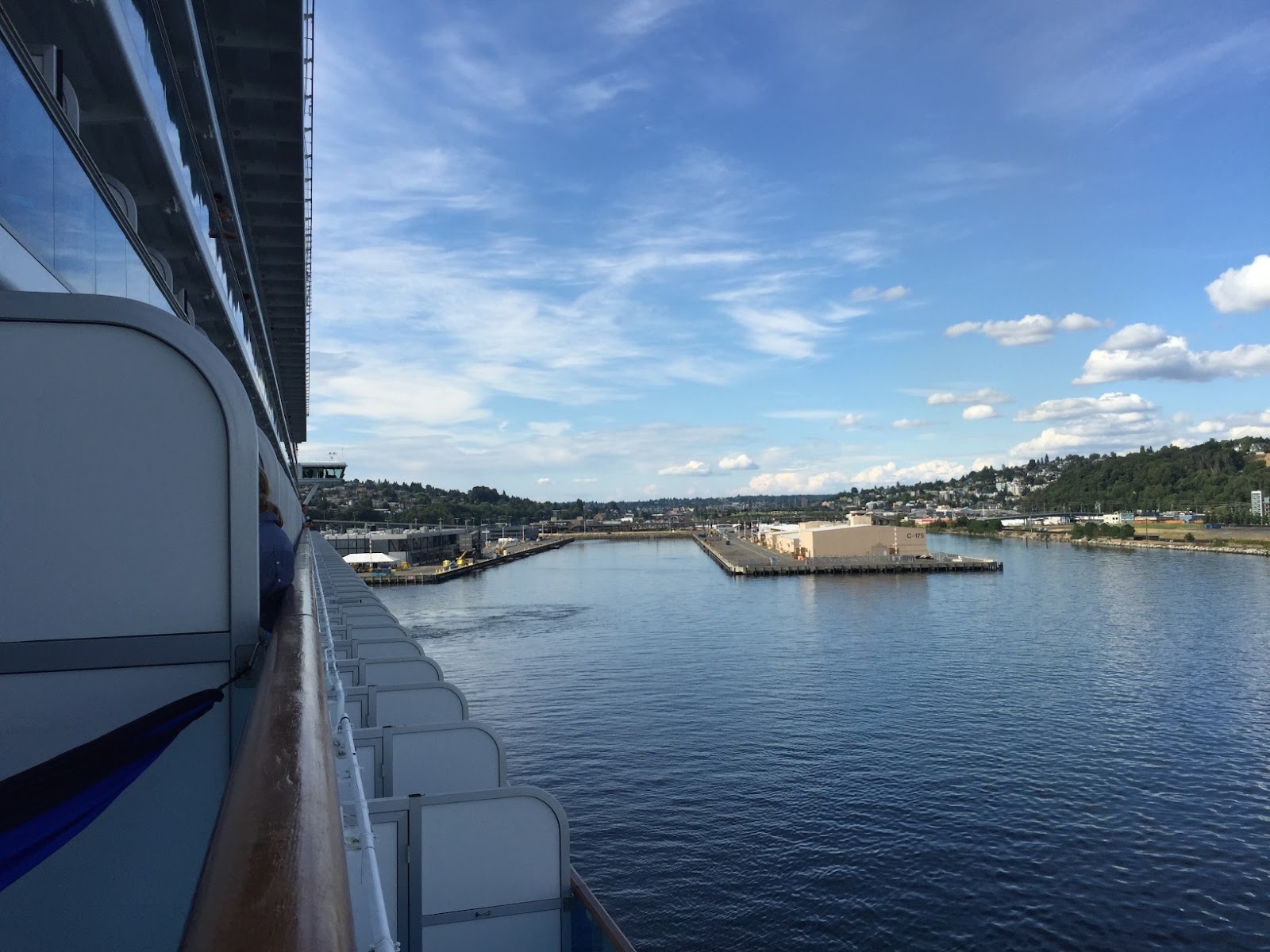
We were due in Seattle about 7am the next morning. I wanted to be up to see the city come into view. About 5 or so the next morning I heard or felt the engines of the ship. I looked outside and
There was Seattle - we were already home!
Mount Rainier was even out to greet us!

It was interesting to watch the smaller boats arrive with supplies for the next cruise. Our ship left later that day to do the same trip - all over again. 
Thanks to our son and his family for inviting us along on this fantastic trip!