Showing posts with label Book. Show all posts

Saturday, January 30, 2021

Book - The Giver of Stars


The Giver of Stars by Jojo Moyes  


"Alice Wright marries handsome American Bennett Van Cleve hoping to escape her stifling life in England. But small-town Kentucky quickly proves equally claustrophobic, especially living alongside her overbearing father-in-law. So when a call goes out for a team of women to deliver books as part of Eleanor Roosevelt's new traveling library, Alice signs on enthusiastically. The leader, and soon Alice's greatest ally, is Margery, a smart-talking, self-sufficient woman who's never asked a man's permission for anything. They will be joined by three other singular women who become known as the Horseback Librarians of Kentucky. What happens to them -- and to the men they love -- becomes a classic drama of loyalty, justice, humanity and passion. Though they face all kinds of dangers, they're committed to their job--bringing books to people who have never had any, sharing the gift of learning that will change their lives. Based on a true story rooted in America's past, The Giver of Stars is unparalleled in its scope. At times funny, at others heartbreaking, this is a richly rewarding novel of women's friendship, of true love, and of what happens when we reach beyond our grasp for the great beyond" (worldcat)


*********


JHKT - This is one of the best books I’ve read in a long, long time. 


Reading this book makes me think about Dad's mother Celia Cathcart Holton and her time at Pine Mountain Settlement School in eastern Kentucky. Based on her work and her writings she loved the people and the countryside in the way that Alice came to love them. Mom's Aunt Nellie Floyd was a librarian at Berea College in Kentucky. She must have been familiar with people who led lives similar to those described in this book. 


“And yet the thought of leaving this place – of no longer riding these mountains, accompanied only by the sound of Spirit’s hoofs and the glinting, dappled light of the forest, the thought of no longer laughing with the other librarians, stitching quietly beside Sophia or tapping her foot as Izzy’s voice soared into the rafters filled her with a grief that was visceral. She loved it here. She loved the mountains and the people and the never-ending sky. She loved feeling as if she was doing a job that meant something, testing herself each day, changing people’s lives word by word. She had earned every one of her bruises and blisters, …” (Alice's thoughts when she contemplated leaving Baileyville, Kentucky)


********** 

This passage about fireflies touched me.  I grew up seeing fireflies. When we moved to Washington state, I met people who have never seen them because fireflies don't live in this part of the country. I miss the magic they bring to a summer evening. 


Fred and Alice sit on his porch. He showed her fireflies. First time she’d seen them. “Alice’s breath stopped in her throat. The mountainside opposite was alive with light, a wall of glinting fairy lights, three-dimensional among the trees, winking and twinkling as they shifted, illuminating the shadows of the inky dark. … Alice couldn’t quite take in what she was seeing. The clouds parted and the fireflies glinted, mingled, traversed upward from the illuminated shadows of the trees, and their million luminous white bodies melded seamlessly with the starry night sky above, so that it seemed for that moment that the whole world was carpeted with tiny golden lights. It was such a ridiculous, unlikely, insanely beautiful sight that Alice found herself laughing out loud, both hands pressed to her face.” 


Fred says “You know what’s really wonderful about those fireflies? …. Sure, they live for just a few weeks. Not much at all in the grand scheme of things. But while they’re there, the beauty of them, well, it takes your breath away. … You get to see the world in a whole new way. And then you have that beautiful picture burned onto the inside of your head. To carry it wherever you go. And never forget it. …  some things are a gift, even if you don’t get to keep them…. Maybe just to know that something this beautiful exists is all we can really ask for.”   

********** 


Hindman School is mentioned here and several other places. Celia’s Sidell, Illinois friend Rosalie Sidell Hoffman taught at Hindman School before Celia went to Pine Mountain Settlement School. 


 This book emphasizes the importance of literacy and the influence of strong, independently minded women. 


Women can overcome negative and oppressive cultural stereotypes. How do you make a difference in a culture that doesn't give you many options? It takes courage and conviction. 


Monday, December 14, 2020

Books

“When I read a book I seem to read it with my eyes only, but now and then I come across a passage perhaps only a phrase, which has a meaning for me, and it becomes part of me.” W. Somerset Maugham 


Some books keep my interest because I'm fascinated by the subject. Or I read a book  because I need or want the information, so I plow through each page. In other books, I enjoy the way the author writes. Sometimes I find myself captivated by the story. 

Every once in a while I come across a passage or phrase that causes me to stop and take in its beauty or meaning or connection with feelings I've experienced.

I am thankful for books. I am thankful my parents emphasized reading. They talked about books. They read books. They filled our home with books. 

I want to leave that same legacy for my family. 

Wednesday, March 4, 2020

Book - Meet the Author

Nathan Dylan Goodwin writes genealogical crime mysteries. He usually publishes a new book just before RootsTech, a genealogy and technology conference. The Sterling Affair, pictured below, is his latest. Note the scarlet and gray RootsTech bags. Wonder if there was an OSU person on the selection committee? 
When an unannounced stranger comes calling at Morton Farrier's front door, he finds himself faced with the most intriguing and confounding case of his career to-date as a forensic genealogist. He agrees to accept the contract to identify a man who had been secretly living under the name of his new client's long-deceased brother. Morton must use his range of resources and research skills to help him deconstruct this mysterious man's life, ultimately leading him back into the murky world of 1950s international affairs of state. Meanwhile, Morton is faced with his own alarmingly close DNA match which itself comes with far-reaching implications for the Farriers. (source)

Goodwin's books are page turners for me. I enjoy the plots as well as reading about  the genealogical methods he uses. Joe would have liked this one. It was all about spies. 

Monday, February 11, 2019

Book - Eleanor Oliphant

 "Smart, warm, uplifting, the story of an out-of-the-ordinary heroine whose deadpan weirdness and unconscious wit make for an irresistible journey as she realizes the only way to survive is to open her heart. Meet Eleanor Oliphant: she struggles with appropriate social skills and tends to say exactly what she's thinking. That, combined with her unusual appearance (scarred cheek, tendency to wear the same clothes year in, year out), means that Eleanor has become a creature of habit (to say the least) and a bit of a loner. 

"Nothing is missing in her carefully timetabled life of avoiding social interactions, where weekends are punctuated by frozen pizza, vodka, and phone chats with Mummy. But everything changes when Eleanor meets Raymond, the bumbling and deeply unhygienic IT guy from her office. When she and Raymond together save Sammy, an elderly gentleman who has fallen on the sidewalk, the three become the kind of friends who rescue each other from the lives of isolation they have each been living. And it is Raymond's big heart that will ultimately help Eleanor find the way to repair her own profoundly damaged one"  (worldcat.org)

***************

JHT - Eleanor made me think about the "loners" I see periodically. Eleanor and Raymond remind me about the huge difference a small act of kindness can make. Eleanor sometimes made me laugh with the way she used language and her matter-of-fact approach to life and people. Eleanor's observations about social conventions, beauty, and other areas of life were often humorous, thought-provoking and spot on. 

While reading the book I often thought of the hymn, "Lord, I Would Follow Thee" in which we sing about walking the path Christ has shown us.

"Pause to help and lift another
...In the quiet heart is hidden
Sorrow that the eye can't see.
...I would learn the healer's art
To the wounded and the weary
I would show a gentle heart"

text Susan Evans McCloud
music K. Newell Dayley

***************

More about Eleanor herehere, and here


Saturday, October 27, 2018

Children - Incomplete Information


As a child, did you ever wish that the big people around you would give you more information about what's going on? I did. 

I think Olsson captured this feeling - “Children have to build their world from such incomplete information. Other people make decisions for them, and only fragments of the rationale are ever conveyed. As children we inhabit a world built of incoherent snippets. The process of embellishing and filling the holes is an unconscious one, I think. And perhaps it continues all our lives."

I felt this as a child. "Filling in the holes" is something I find myself trying to do as I look at our family's timeline and stories - trying to understand what happened and why. 

Wednesday, February 21, 2018

Books - Poldark - One More Time

I like the Poldark series by Winston Graham so much that I asked for and received the whole series, 12 books, for Christmas.First time around, I borrowed the books from the library.


"Poldark is a series of historical novels by Winston Graham, published from 1945 to 1953 and continued from 1973 to 2002. The series comprises 12 novels: the first seven are set in the 18th century, concluding in Christmas 1799; the remaining five are concerned with the early years of the 19th century and the lives of the descendants of the previous novels' main characters. Graham wrote the first four Poldark books during the 1940s and 1950s. Following a long hiatus, he decided to resume the series and published The Black Moon in 1973.

The main character, Ross Poldark, is a British Army officer who returns to his home in Cornwall from the American Revolutionary War only to find that his fiancĂ©e Elizabeth Chynoweth believed him dead and is about to marry his cousin Francis Poldark. Ross attempts to restore his own fortunes by reopening one of the family's derelict tin mines. After several years, he marries Demelza Carne, a poor servant girl, and is gradually reconciled to the loss of Elizabeth's love." Wikipedia

Just recently I started Book #1 again. So far, it's even better the second time around. 

You can tell how much I enjoyed the books by checking out the blog posts I wrote as I read the books the first time. Read more here and here

Click here for a summary of all the books. 


Friday, November 3, 2017

Book - Worth the Wrestle


Why can’t I seem to conquer weaknesses that plague me?” “How do I know if I’m receiving revelation?” “Will the Lord forgive me after what I’ve done?” ...

Those are just a handful of the countless questions Sheri Dew has heard people ask over the years. “May I answer these questions,” she writes, “and any questions you may have, by posing a different question: Are you willing to engage in the wrestle? In an ongoing spiritual wrestle?” 

In Worth the Wrestle, Sheri examines the process of asking good questions—whether those questions be doctrinal, procedural, historical, or intensely personal—and learning how to get answers.  (book jacket)

**********
"Asking inspired questions leads to knowledge. It leads to revelation. It leads to greater faith. And it leads to peace.” 

I don't know how many of my questions are "inspired," but I have asked many questions over the years. Sometimes I've received revaluation. Often I gain peace and greater faith even when the questions aren't answered right away.  

“… we can either live our lives alone, relying largely upon our own strengths, or we can live them with the help of heaven. How much help we receive from Above is largely up to us.” 

My experience is that life is much more doable when we call on God for help and then accept the help that is given. 


Friday, September 29, 2017

Book - Poldark Series

I just finished "Bella Poldark," the 12th and last book in Winston Graham's Poldark series. I'm sad to see the series end.

from the publisher - "The bestselling Poldark series is loved across the world for its compulsive blend of romance, drama, unforgettable characters and beautifully evocative portrayal of Cornwall.


The saga, which spans the late Eighteenth and early Nineteenth centuries, follows the life of the brooding, principled Ross Poldark; a young man who returns from the American Revolutionary war to find his father dead, his copper mine failing and his childhood sweetheart, the beautiful Elizabeth Chynoweth, engaged to his cousin. Romance, intrigue, betrayal, and one of the most heart-breaking love triangles in modern fiction ensue as Ross falls in love with the charming Demelza, and tries to build a better world for her and their children whilst fighting his arch-enemy, the swaggering and ruthless financier, George Warleggan." Pan Maccmillan

************
JHT's comments - I never found "aha," notable, quotable phrases in Graham’s books. What I did find were wonderful passages about people and places. He has a way of conveying the contentment we sometimes feel not necessarily because there aren’t any problems in our lives but because we are with the people we love in a place we love. There is also a sense that life goes on no matter the ups and downs of our lives.

I enjoyed the history of the time and place. Until I read these books I didn’t realize how much fighting was happening between European nations during this time period.

Due to space considerations I borrow more books than I buy these days. This is a series I will purchase and read again and again.

The land of Cornwall almost becomes a character in these books. Graham conveyed his love of Cornwall in the beautifully illustrated book titled "Poldark's Cornwall." It's worth checking this out if you read any of the Poldark books. 

Click here for an overview of all 12 books. 

PBS is now airing Season 3 of Poldark. You can watch the first two seasons on Amazon Prime. I've enjoyed the TV series but I like the books better. 


Friday, September 22, 2017

Penultimate

"Penultimate" is one of those words that has caught my fancy for some reason. Dad delighted in certain words and I might have caught this tendency from him.

Penultimate means next to last. Ultimate is from the Latin word "ultimus" for last and "pen" is a Latin prefix that means "almost."

More here
******************

"The Twisted Sword" is the penultimate book in Winston Graham's 12 book Poldark series. I don't want the series to end. 
******************

In case you're wondering, there is a word for third from last. It's antepenultimate. It doesn't roll off the tongue the way penultimate does!

Thursday, June 29, 2017

Geraldine Brooks

So many things to love about our community. Recently I was able to go to the nearby performance center to enjoy listening to a great author - and it was free!

Geraldine Brooks is the author of five novels, the Pulitzer Prize–winning MarchCaleb’s CrossingPeople of the BookYear of Wonders, and The Secret Chord. I've read all but this last one. 

People of the Book is one of those books I read every few years. See my post about People of the Book here and Caleb's Crossing here.

Born and raised in Australia, Brooks came to Columbia University on a scholarship to the journalism master’s program. She mentioned to a fellow student that when she was younger she had a penpal from Menemsha on Martha’s Vineyard and that she’d always wanted to go there. The man mentioned he lived on Martha’s Vineyard and invited her to come with him that weekend and he’d take her to the town. She accepted. She went to Martha’s Vineyard and later married that man, Tony Horwitz.

She and her husband traveled the world for 12 years as foreign correspondents for the Wall Street Journal. Eventually they settled down on Martha’s Vineyard to raise their family. While living there, she became acquainted with the story of Caleb (Cheeshahteaumauck), a Wampanoag, who was the first Native American to graduate from Harvard, in 1665. 

What are the chances of a girl from Australia to get a pen pal from Martha’s Vineyard? Then to move to the States and have a classmate who lives on Martha’s Vineyard. Marry that man and live on Martha’s Vineyard where she learns about Caleb. She must have been destined to tell his story.

Some notes I made from her presentation in Kirkland - 

Talking about subjects for her books - find implausible truths. Write about "shards of history." She said she tries to hear "the unheard voices." 

Brooks said the key to art is to keep doing it. She doesn't believe in "writer's block." As a journalist she had to produce stories according to deadlines. There could be no writer's block. Brooks said writing is much like a description a friend gave of producing art - "Mess, mess, mess, art!" You have to get started and make the "messes" before you can have "art."

Geraldine Brooks' website
NPR interview with Brooks 
More about Cheeshahteaumauck herehere, and here  
*******************

A totally unrelated tidbit discovered while finding links for this post - At one point one in four children was born on Martha's Vineyard! More here 

Tuesday, October 11, 2016

Book - Mr. Rosenblum Dreams in English

Mr. Rosenblum Dreams in English by Natasha Solomons 

After escaping Germany during WWII, Jack and Sadie Rosenblum, together with their baby daughter, settle into a life of acting "English." In post-war England, however, no golf club will admit a Rosenblum. So Jack hatches a wild idea: he'll build his own. It's an obsession Sadie does not share, particularly when Jack relocates them to a thatched roof cottage in Dorset to embark on his project.  worldcat - image & summary 

JHT - When the Rosenblums arrive in England they are given a pamphlet written for immigrants on how to act like the English. This list becomes Jack's blueprint for fitting in. Wife Sadie years for life back in Germany. She is obsessed with remembering and doesn't want to become English. 

Author Natasha Solomons uses her grandparents' experiences as the basis for this book. They were Jews who left Germany to settle in England. Internet searches didn't reveal whether or not her grandfather built a golf course as Jack did in this story. 

This wasn't a page-turner for me. At times I came close to giving up on the book. I'm glad I persevered. When I read the last few pages, the word that came to my mind was "sweet." Jack and Sadie both found friendship and a new home and they rekindled their love and appreciation for each other. 

I read the author's The Song of Hartgrove Hall and requested two of her other books from the library. This author is Jewish; religion or ethnic background seems to be an aspect of each of her books. 

Themes I noticed – friendship, belonging, and relationship with the land. Can you remember the past in a way that it doesn't interfere with enjoying and learning from the present?

Read more at goodreads.com


Wednesday, September 14, 2016

Book - Louisa: The Extraordinary Life of Mrs. Adams

Louisa: The Extraordinary Life of Mrs. Adams
 by Louisa Thomas

"Born in London to an American father and a British mother on the eve of the Revolutionary War, Louisa Catherine Johnson was raised in circumstances very different from the New England upbringing of the future president John Quincy Adams, whose life had been dedicated to public service from the earliest age. ... They lived in Prussia, Massachusetts, Washington, Russia, and England, at royal courts, on farms, in cities, and in the White House."  goodreads.com
********

JHT's comments – I highly recommend this book. It's a wonderful insight into the early days of this country and women's often untold contributions to that history. The author feels that John Quincy Adams probably would not have become president of the United States without the help and skills of his wife.

John Quincy Adams held a series of overseas appointments. When approaching people, he often had to explain what the United States of America was. The country was that new.  “He was representing a nation that did not exist in the minds of many. What was worse, the traditional great powers of Europe generally treated the young nation as an annoying child.” (89) Louisa accompanied him to all these assignments. At one point her in-laws, John and Abigail Adams decided Louisa and John Quincy's two young sons should remain with them in Massachusetts instead of going overseas. Louisa suffered numerous miscarriages under what must have been very difficult circumstances. A daughter was born in St. Petersburg, Russia and died a year later. 

Louisa has much to say about women and their roles. She also has a lot to say about politicians. Reading some of her comments, it comes to mind that some things never change. 

Here's an interesting article about America's first foreign born first lady.

Click here for more information from the author's website

See more at goodreads.com

Monday, August 8, 2016

Book - Tuesdays With Morrie

Tuesdays with Morrie

"Maybe it was a grandparent, or a teacher. Someone older who understood you when you were young and searching, who helped you see the world as a more profound place, and gave you advice to help you make your way through it. For Mitch Albom, that person was Morrie Schwartz, his college professor from nearly twenty years ago. Maybe, like Mitch, you lost track of your mentor as you made your way, and the insights faded, and the world seemed colder. Wouldn't you like to see that person again, ask the bigger questions that still haunt you? Mitch Albom had that second chance. He rediscovered Morrie in the last months of the older man's life. Knowing he was dying, Morrie visited with Mitch in his study every Tuesday, just as they used to back in college. Tuesdays With Morrie is a magical chronicle of their time together, through which Mitch shares Morrie's lasting gift to the world." --From the publisher. (image & summary from worldcat.org)
***************

Several people have recommended this book recently. I read many reviews in which people said the book is shallow with one person saying it's like a collection of greeting cards. Others commented it's the most inspiring and profound book they've ever read. 

The author and Morrie don't discuss God, but I found that most of Morrie's observations are rooted in the gospel of Jesus Christ.  I think that's why this book and Morrie have resonated with many readers.

Morrie determined long before he got sick to create a culture around himself that made him and others feel good about themselves. “Morrie ... had developed his own culture – long before he got sick. Discussion groups, walks with friends, dancing to his music … He took more time eating and looking at nature ... He had created a cocoon of human activities – conversation, interaction, affection – and it filled his life like an overflowing soup bowl.”

“The most important thing in life is to learn how to give out love, and to let it come in.”

Author Albom looking at Morrie & seeing how ALS (Lou Gehrig's Disease) has affected his body – “The disease owns him.” 
  
“Devote yourself to loving others, devote yourself to your community around you, and devote yourself to creating something that gives you purpose and meaning.” 

Morrie commented that most people just don't realize how "important" marriage is. 

"...the biggest defect we human beings have is our shortsightedness. We don’t see what we could be. We should be looking at our potential, stretching ourselves into everything we can become.” jht - We are children of God. Our divine heritage gives us unlimited potential.

Ted Koppel interviewed Morrie for television several times. During their last interview, Morrie says, “Ted, this disease is knocking at my spirit. But it will not get my spirit. It’ll get my body. It will not get my spirit.” (italics in original) jht - Our spirits will continue into the next life. 

Morrie – “Death ends a life, not a relationship.” jht - We would add to this, death ends life here on earth, then there is life on the other sideRelationships can continue on the other side. 

jht - I am reminded that time, attention, and focus (no multitasking) are gifts we give each other, any time, but especially when a person's body is greatly affected by age or disease. 


SaveSave

Wednesday, July 20, 2016

Book - When Breath Becomes Air

When Breath Becomes Air  
 by Paul Kalanithi

"... a profoundly moving, exquisitely observed memoir by a young neurosurgeon faced with a terminal cancer diagnosis who attempts to answer the question What makes a life worth living? At the age of thirty-six, on the verge of completing a decade's worth of training as a neurosurgeon, Paul Kalanithi was diagnosed with stage IV lung cancer. One day he was a doctor treating the dying, and the next he was a patient struggling to live. And just like that, the future he and his wife had imagined evaporated. When Breath Becomes Air chronicles Kalanithi's transformation from a naĂŻve medical student "possessed," as he wrote, "by the question of what, given that all organisms die, makes a virtuous and meaningful life" into a neurosurgeon at Stanford working in the brain, the most critical place for human identity, and finally into a patient and new father confronting his own mortality. What makes life worth living in the face of death? What do you do when the future, no longer a ladder toward your goals in life, flattens out into a perpetual present? What does it mean to have a child, to nurture a new life as another fades away? These are some of the questions Kalanithi wrestles with in this profoundly moving, exquisitely observed memoir. Paul Kalanithi died in March 2015..."  image & summary from worldcat.org

*********************
“I hadn’t expected the prospect of facing my own mortality to be so disorienting, so dislocating.” (163) 
       
“As furiously as I had tried to resist it, I realized that cancer had changed the calculus. For the last several months, I had striven with every ounce to restore my life to its precancer trajectory, trying to deny cancer any purchase on my life. As desperately as I now wanted to feel triumphant, instead I felt the claws of the crab holding me back. The curse of cancer created a strange and strained existence, challenging me to be neither blind to, nor bound by, death’s approach. Even when the cancer was in retreat, it cast long shadows.” (176)

Epilogue written by Paul’s wife Lucy Kalanithi

“… we knew that one trick to managing a terminal illness is to be deeply in love – to be vulnerable, kind, generous, grateful. A few months after his diagnosis, we sang the hymn “The Servant Song” while standing side by side in a church pew, and the words vibrated with meaning as we faced uncertainty and pain together: ‘I will share your joy and sorrow / Till we’ve seen this journey through.’” (228) 
        jht – My sister sent this hymn to me a few months ago – beautiful words. Read about it here

 “What happened to Paul was tragic, but he was not a tragedy.” (234)
        jht – so very, very true. This is a very important distinction. 

C.S. Lewis “Bereavement is not the truncation of married love, but one of its regular phases – like the honeymoon. What we want is to live our marriage well and faithfully through that phase too.” (235)
        jht – It's all part of the journey, especially when that journey and marriage are eternal and continue on the other side of the veil. 

Talking about being surrounded by family & friends at the end – “And yet we did feel lucky, grateful – for family, for community, for opportunity, for our daughter, for having risen to meet each others at a time when absolute trust and acceptance were required. Although these last few years have been wrenching and difficult – sometimes almost impossible – they have also been the most beautiful and profound of my life, requiring the daily act of holding life and death, joy and pain in balance and exploring new depths of gratitude and love. … Relying on his own strength and the support of his family and community, Paul faced each stage of his illness with grace – not with bravado or a misguided faith that he would “overcome” or “beat” cancer but with an authenticity that allowed him to grieve the loss of the future he had planned and forge a new one.” (230 )

**********

New York Times interview with author's wife Lucy

Saturday, July 16, 2016

Books - Garbage Land & Bottlemania

I tend to take water and garbage for granted. They are part of every day life - one vital to our well-being and the other a fact of life. Elizabeth Royte has written a book on each subject. Very interesting reading. 

****************
Garbage Land: On the Secret Trail of Trash

"Out of sight, out of mind ... Into our trash cans go dead batteries, dirty diapers, bygone burritos, broken toys, tattered socks, eight-track cassettes, scratched CDs, banana peels.... But where do these things go next? In a country that consumes and then casts off more and more, what actually happens to the things we throw away? In Garbage Land, acclaimed science writer Elizabeth Royte leads us on the wild adventure that begins once our trash hits the bottom of the can. .......... By showing us what happens to the things we've "disposed of," Royte reminds us that our decisions about consumption and waste have a very real impact-and that unless we undertake radical change, the garbage we create will always be with us: in the air we breathe, the water we drink, and the food we consume." summary from goodreads.com image from worldcat
********
As I read this book I got the feeling that often we're just shifting our trash from one place to another. Evidently only 2% of all garbage is household waste. "The rest of it [waste] is industrial, primarily manufacturing and commercial, mostly restaurants and fast food outlets. ... for every 100 pounds of manufactured goods, 3,200 pounds of waste are generated."  source 

When I drop something into the garbage or recycling container, I wonder about its final destination. 

**************************************

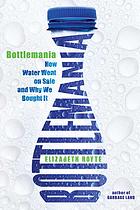
Bottlemania: How Water Went on Sale and Why We Bought It
by Elizabeth Royte

"An investigation into the commercialization of drinking water traces the process through which companies acquire, bottle, and market water, in an account that addresses such issues as the risks of water-decontaminating practices." (summary & image from worldcat.org)

read more at goodreads.com

thought-provoking questions

"Is it right to trade water at all, to move it from its home watershed to other states, or even countries? Should the taxpayers who protect land and water share the profits of those sho pump and sell that resource? How is water different from such resources as oil, trees, or lobsters?" (15)

“… who controls what’s left of our freshwater – locals who depend on it for survival, or corporations that sell it for profit – matters a great deal, whether that water comes from an aquifer in western Maine, or an aquifer in the Philippines, … where companies have already privatized either supplies or delivery systems." (53)

If people switch to bottled water will there be support for public water supplies and infrastructure to provide safe tap water?

Elizabeth Royte's blog
Elizabeth Royte's website


Thursday, June 2, 2016

Book - Being Mortal

 Being Mortal: Medicine and What Matters in the End

"Medicine has triumphed in modern times, transforming birth, injury, and infectious disease from harrowing to manageable. But in the inevitable condition of aging and death, the goals of medicine seem too frequently to run counter to the interest of the human spirit. Nursing homes, preoccupied with safety, pin patients into railed beds and wheelchairs. Hospitals isolate the dying, checking for vital signs long after the goals of cure have become moot. Doctors, committed to extending life, continue to carry out devastating procedures that in the end extend suffering. Gawande, a practicing surgeon, addresses his profession's ultimate limitation, arguing that quality of life is the desired goal for patients and families. Gawande offers examples of freer, more socially fulfilling models for assisting the infirm and dependent elderly, and he explores the varieties of hospice care to demonstrate that a person's last weeks or months may be rich and dignified." (image & summary from worldcat.org)

******

The author, a surgeon, discusses the fact that old age and death have been turned into medical experiences. Sometimes we get so fixated on the "repair of health" (even when the "repair" can cause more problems than it fixes), that we neglect the "sustenance of the soul." (128) 

When you get older there are some things that just can't be "repaired." But we always can sustain our souls no matter what's going on physically. 

more reviews at Goodreads.com


Saturday, May 28, 2016

Book - A Higher Call

A Higher Call: An Incredible True Story of Combat and Chivalry in the War-Torn Skies of World War II
by Adam Makos with Larry Alexander

"Four days before Christmas 1943, a badly damaged American bomber struggled to fly over wartime Germany. At its controls was a 21-year-old pilot. Half his crew lay wounded or dead. It was their first mission. Suddenly, a sleek, dark shape pulled up on the bomber’s tail—a German Messerschmitt fighter. Worse, the German pilot was an ace, a man able to destroy the American bomber in the squeeze of a trigger. What happened next would defy imagination and later be called the most incredible encounter between enemies in World War II."  (goodreads.com)
  
******
JHT’s comments – I became totally engrossed in this book. I wish I had asked Dad and his friends more about their involvement in World War II. The men were so very young. I can’t imagine what it felt like to be in countries that were being bombed. The descriptions of aerial fights are amazing.

The youth of the pilots, the feelings of some in the German Air Force about Hitler and his staff, the huge number of bombers in the air at one time after the United States joined the war, … This book gives insights into the feelings and experiences of those who were waging war from the air.


 (image from worldcat.org)

Sunday, May 1, 2016

Book - People of the Book

People of the Book by Geraldine Brooks

"A fictionalized account of the turbulent history of the Sarajevo Haggadah, an illuminated manuscript which has survived into the twentieth century thanks to people of various faiths who risked their lives to safeguard it. Hanna Heath, a manuscript conservator hired to restore the manuscript in 1996 Sarajevo, finds and pursues clues to crucial moments in the book's history." summary & image

****************
Coming from a family that loves books, I can relate to the people who safeguarded this 14th century book through hundreds of years. When I hold family Bibles that are several hundred years old, I can feel the love people have had for the books throughout the generations. 

In Brooks' book - I am interested in the interactions between people of different faiths and how they stepped up to protect each other, and the book. The setting of the book involves parts of the world that are still in turmoil. 

Read more about the actual manuscript herehere, and here.  The story of the genuine Sarajevo Haggadah is just as interesting as Brooks' "People of the Book," maybe mores. I hope it is still being protected.