Tuesday, July 28, 2015

Cruise - Ketchikan, Alaska

Ketchikan, Alaska is known as the salmon capital of the world. About 13,000 people live in Ketchikan area. It's the southeasternmost city in Alaska. Ketchikan is Native American name for the creek that runs through the town. Various meanings are attributed to the word. Timber was a major industry until government regulations reduced the harvest in the Tongass National Forest.

We were in Ketchikan about 8 hours. Speaking with the owner of a Ketchikan store - the four cruise ships docked that day brought 7,000 people to town. He said about half the people get off the ships. Townspeople have a calendar that shows which ships and how many people come on which days. 

Ketchikan


See the other cruise ship behind us? 
We were often in sight of other ships - same itinerary as ours.


Click on a photo for larger images
Tour buses and taxis wait for excursion customers

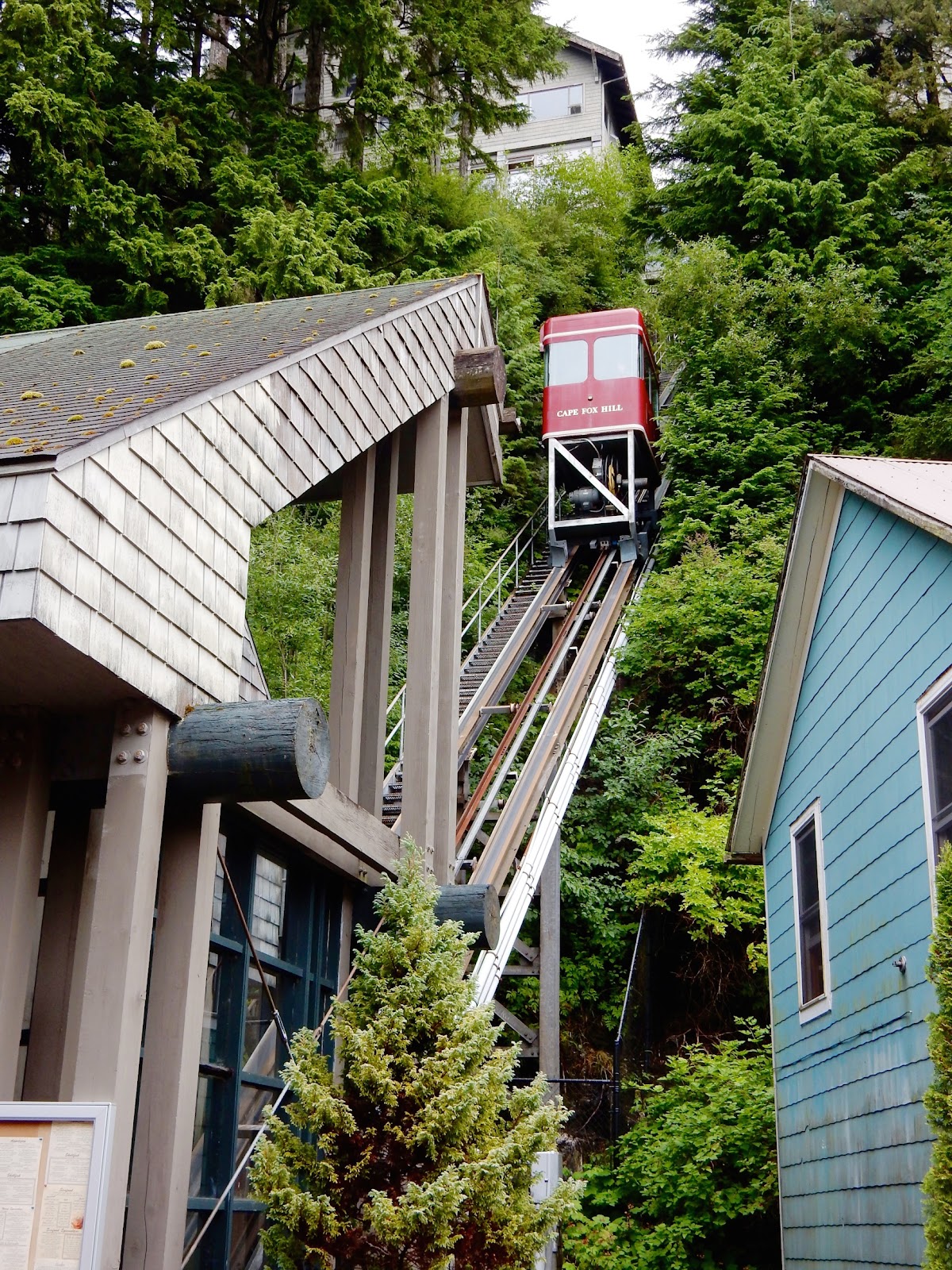
Cape Fox Hill-Creek Street Funicular (known as "the tram")

Creek Street has a very colorful history. It's now full of shops for tourists. The street was built over the creek because it was easier than blasting away the rock of the mountain. 


The Rock - figures from Ketchikan's past
Lots of floatplane activity in Ketchikan

Ketchikan is in the middle of a rain forest and gets 13 feet of rain in a year!

Ketchikan has the world's largest collection of standing totem poles. Read more here.


Monday, July 27, 2015

Cruise - The Ship

This was our first cruise. We are still trying to process the enormity of the ship and the logistics of running this floating city. How do you bring together 3,000+ passengers and 1,200 crew from all over the world and make it a wonderful experience? 
Ruby Princess docked at Victoria, British Columbia
Ruby Princess docked at Juneau, Alaska

Statistics for this floating city
built in 2008 for cost of $400 million
passengers 3,080 
crew 1,200
length 951 feet 
height 195 feet
beam/width 159 feet including bridge wing, 118 excluding the wing
number of decks 19
speed 26 miles per hour
pools 4
click here for more statistics
Our cabin when we arrived - The brown leather panel is on the bed to protect the bed while we unpacked the luggage. Experienced cruisers recommended that we spend the extra money to get a room with a balcony. Great advice. The room didn't feel cramped. It was nice to sit in the room or on the balcony and watch the world go by. 
The bathroom was very small but had all the necessities. 


Docked at Ketchikan, Alaska - follow the light pole up to the third deck - Joe is the tiny speck of black just to the right of the pole. He's standing on our balcony. 
Getting thousands of people on and off the ship was interesting. This multistory gangplank made us feel we were in an extra long security line as we wound our way on and off the ship at Seattle. In the other ports shorter ramps were used to deal with the smaller numbers of people getting on and off the ship. 
On the ship - looking down at the luggage soon to be brought to our cabins. You could bring on your own luggage if you wanted to wrangle it up the giant gangplank. 
At the end of the cruise - luggage waiting to be claimed. Each bag had a colored tag corresponding with each passenger's disembarking time. You could take luggage off yourself and avoid this confusion of bags. 
We were fascinated by the crew. We interacted with a small percentage of the 1,200 crew but were impressed with all we met. Each crew member's name tag gave a home country. We were told by several people that the crew represented 17 countries. We didn't meet anyone for whom English was the first language. How do you bring that many people together from such diverse cultures, countries, ethnic groups, languages, ... and shape them into a group that gives top notch service - in English? Crew would light up when we were able to connect with him/her and his/her country through an experience in travel or acquaintance from the country.  

The multistory Piazza was a gathering place
Entertainers performed here frequently throughout the day
There’s an abundance of entertainment and education options on the ship. The children and I went to a class on digital photography. Most of us went to “Up Close with Magician Garry Carson.” Carson taught us how to do some tricks. Our grandchildren attended the various clubs and activities for their age groups. Our son and his wife went to a lecture on the food aspects of the cruise and got a tour of a kitchen. Various people took advantage of exercise classes, workout room, teens’ club and the kids’ club (for children Caleb’s age). 

We went to a lecture by Libby Riddles, the first female to win the Iditarod and another talk by naturalist Jules Talarico about the wonders of Alaska. We also enjoyed a talk by an author Nick Jans who wrote a book about a black wolf that adopted some of the people and animals in Juneau. Jans and Talarico tried to articulate those special, almost sacred, experiences with animals in which you are in awe of who they are and, if you’re lucky, you have some sort of very special connection with them.

These men juggled and one of them was a sword swallower
There were shows and musicians galore
This ship had four pools and numerous hot tubs. Movies were shown at night on a giant screen above one of the pools. The children went to some of the movies. Everyone bundled up with blankets on the lounge chairs because it was chilly - we were in Alaska after all. Servers brought around pizza, ice cream, popcorn, cookies and milk - a person could get used to this!
This channel on the room's TV was a feed from a camera on the front of the ship. This shows us in port at Juneau, Alaska. Sometimes a naturalist would talk about the sights.
The ship is so huge that it's hard to get it in one photo.

At sea - sometimes we could feel the movement but most of the time we weren’t aware we were moving unless we looked out the window. One morning we could feel the waves enough that some of us got queasy stomachs and it was a little tricky to walk. Fortunately that didn’t last more than a few hours. 
It was truly smooth sailing with beautiful views


Sunday, July 26, 2015

Cruise - Itinerary & Borders

One of our children invited us to join them on a cruise fro Seattle to Alaska. 
What a fantastic experience this was!
It was wonderful to start a vacation with a 20 minute cab ride, get on the ship and not have to pack and unpack for a week - and to have meal preparation and cleanup taken care of. This was our first cruise. It was a nice way to travel. To do it with family made it even more wonderful.


Before the cruise I took out an old-fashioned paper map to look more carefully at Alaska. I've enjoyed map reading from my early years. The maps that came with National Geographic were fascinating to me. I realized we'd be cruising in Alaska's panhandle and not in the larger part of Alaska, nearer where Joe was stationed on Kodiak Island, Alaska when he was in the Navy. I realized I'd never thought about why most of Canada's western border stopped short of the Pacific Ocean and how that narrow strip of land was part of Alaska and later the United States and not Canada.

How did that panhandle end up with Alaska and not Canada? It can be traced back to 1821 when a fur trading business called Russian-American Company, with a charter from the czar, claimed ownership of the land along the Alaskan coast north of the 55th parallel. That mean the Russians' claim went all the way down to Vancouver, Canada which was an important British port. The US and Britain teamed up to protect Britain's access to Vancouver. Russia gave up claim to a large tract of land south of the 60th parallel (now the southern border of Alaska) with the exception of the panhandle area. This gave Russia the strip of land between the ocean and the western mountains. The area contained safe harbors for Russia's ships and fishing boats. When the United States bought Alaska, the States claimed all the land shown on Russian maps. Establishing the eastern border of the panhandle became a matter for negotiations between Canada and the United States in 1903. Read more here and here.

A book I find fascinating is "How the States Got Their Shapes" by Mark Stein. See pages 20-21 in the link.  There's also a TV series based on the book.

map & itinerary


Click here to see pictures of a trip that was very similar to ours - fantastic photos & descriptions

Saturday, July 25, 2015

Continue Steadfastly

Then they that gladly received his word were baptized: and the same day there were added unto them about three thousand souls. 42 And they continued steadfastly in the apostles’ doctrine and fellowship, and in breaking of bread, and in prayers. Acts 2:41-42

This scripture describes the wonderful events of the Day of Pentecost and the depth of the people's conversion. 

Definitions for steadfast include resolute, dutiful, firm, unwavering. Synonyms are loyal, true, constant, devoted. 

That's the kind of disciple of Christ that I want to be.